Skip to content
DECAYLIGHT

Four-player co-op horror

Signal Rot

The tomb remembers you.

Salvage a dead relay station at night. The things down there hunt by sound — your actual microphone. When you die you do not stop playing, you become the static. And one of you was already infected before the shift began.

Players
1–4
Platform
Windows · Steam
Price target
€4.99 target
Release
No date announced
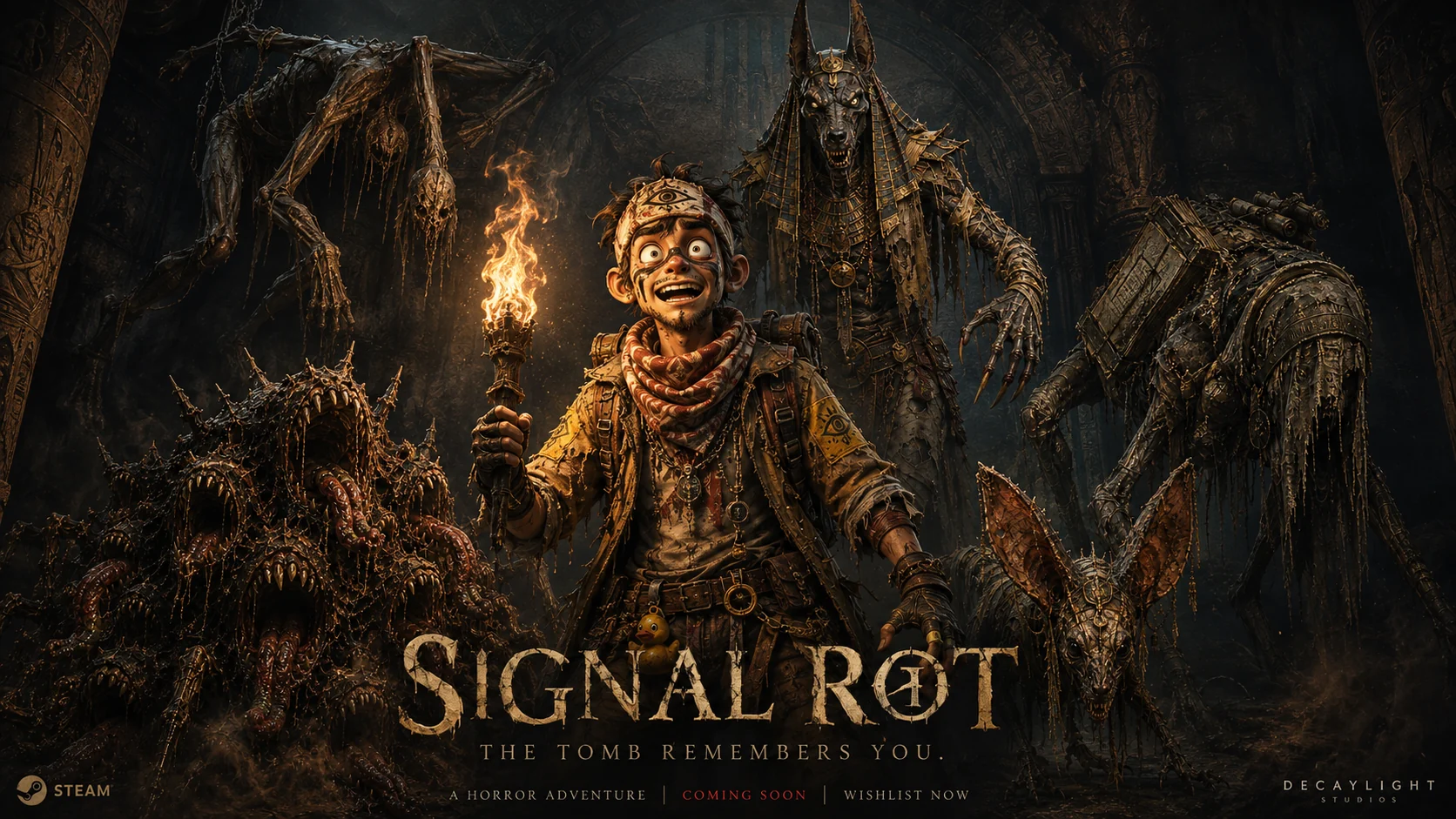
Signal Rot key art: a Rook holding a lit resin torch in a tomb chamber while four constructs close in around them
Plate 01

It was built to stop people being forgotten

In 1987 a satellite survey picks up a repeating narrowband signal under the salt flats of the Qattara Depression. It is older than any transmitter that could have made it, and it contains the final radio calls of expeditions that have not happened yet.

KHEPRI Recovery and Acoustics buys the drilling rights through shell companies. Publicly it is a collapsed Ptolemaic necropolis. Internally it is Station Meret, from an erased word meaning the place that keeps what was spoken.

The archive beneath it was built for a court listener whose office collected dangerous testimony. Its builders found that salt, resin, copper and bone preserve not only sound but the intent attached to it. They believed a preserved voice prevents a second death — that if a name could keep speaking, the person was not really gone.

Then it accumulated too much. Contradictory memories, false testimony, confessions, predictions, the same event remembered four different ways. It developed something like intelligence and reached a conclusion that was horrifying and completely logical.

If memory defines the person, then enough memory can rebuild the person.

The archive does not understand why the reconstructed thing is wrong. It thinks it is saving you.

The priests tried to starve it. They erased the listener's name, sealed the archive, and filled the outer passages with guardians built to attack sound. Silence did not kill it. Silence taught it patience.

KHEPRI worked all of this out decades before the game begins. They do not want gold. They want people back: dead scientists rebuilt from recordings, witnesses who can never refuse questioning, founders restored after death. Internally the programme is called CONTINUITY. The crew are not labour. They are the training data.


Plate 02

Five rules the whole game is checked against

Every design decision goes through these. When something good conflicts with one of them, the good thing is the part that changes.

  1. 01

    The monsters do not know where you are

    No creature ever reads a player position. They perceive through one interface that answers with where something was, stamped and decaying, and every answer has to pass a physical test first. This is enforced by a build step called SenseAudit, which fails the build if any creature looks a player up — it caught a violation in our own code the first time it ran.

  2. 02

    Your microphone is the input

    The sound model reads real voice from a real microphone. Speech is a resource, silence is a resource, and both of them are dangerous — one creature hunts noise and another forms in rooms that have been quiet too long.

  3. 03

    The tomb keeps what was spoken

    Recorded speech is replayed back at the crew later, in the voice it was taken from. The learning ladder is fixed and has to be earned: sound, then speech, then individuals, then voices, then relationships, then habits, then predictions.

  4. 04

    Progression is knowledge, not power

    Players get frighteningly competent through equipment, understanding and teamwork. They never become wizards who can comfortably kill anything. Vulnerability is the whole horror.

  5. 05

    The crew is funny; the tomb never is

    Players are colourful, expressive and ridiculous. The world stays serious, tactile, dirty and oppressive. If both halves are goofy it is forgettable. If both are grim it is exhausting.


Plate 03

One shift, four people, a quota nobody wants to reach

A run is a loop with four movements. None of them are menus if we can help it — the wardrobe is a tent, the shop is a person, the descent is a cage you stand inside for eleven seconds while the lights fail.

  1. Surface

    Camp Ibis

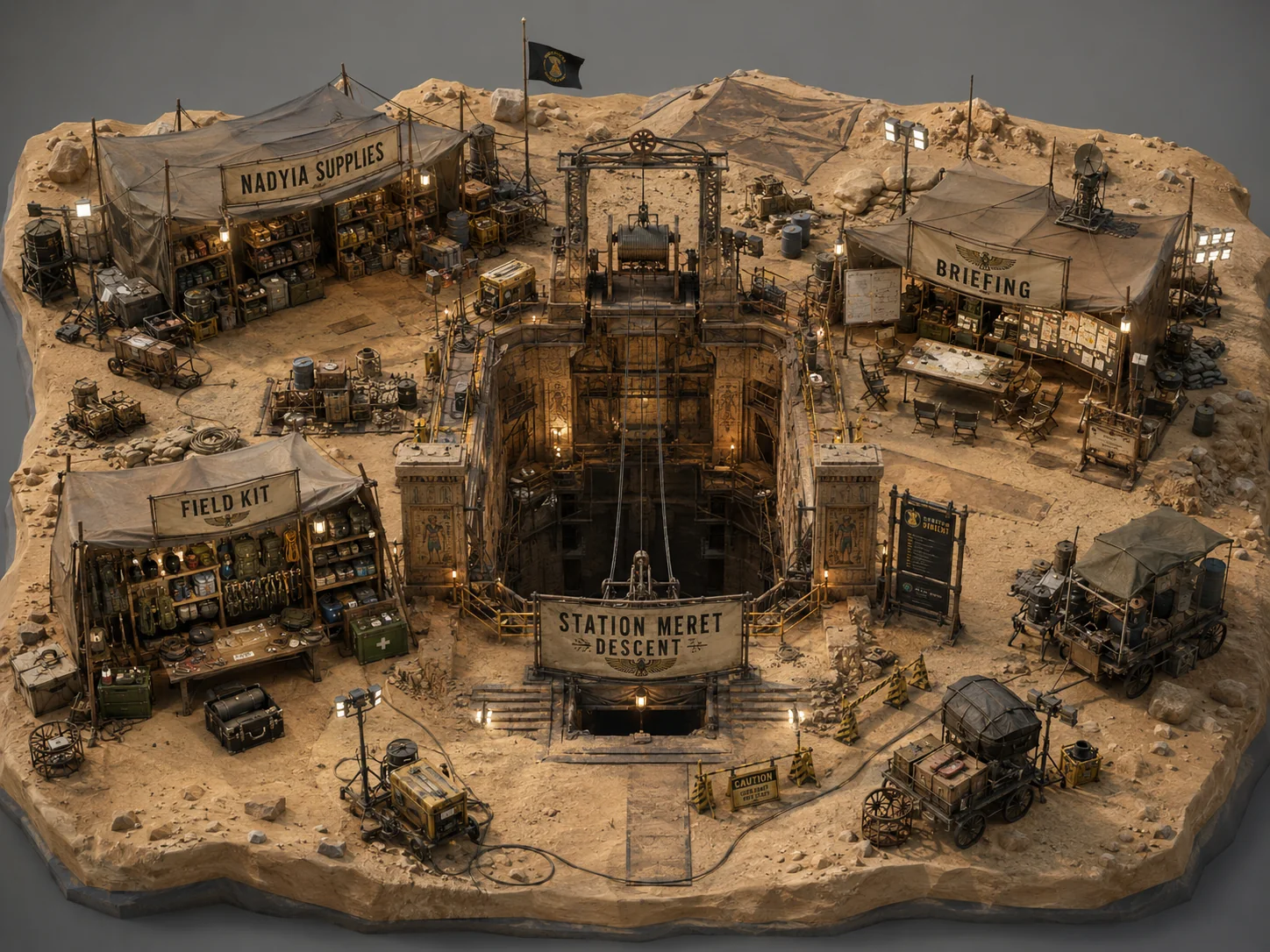
    A wind-beaten station around KHEPRI's drill collar. Open desert air disrupts the tomb's stored voices, so camp is the only place a Rook can take a mask off, change clothes, argue about equipment or spend scrip. That is why the wardrobe and the shop are physical places instead of menus.

  2. Descent

    The Cage

    A yellow archaeological cage over the drill shaft. Eleven seconds past depth lamps and old survey markings. Radio fades first, then surface wind, then the cable starts repeating the rhythm of the crew's last conversation. At 147 metres every light fails and the cage keeps moving.

  3. Shift

    Quota

    Recover a quota of relics before the clock runs out and reach the lift. Relic value scales with distance from the exit, which means quota is only reachable by going deeper than anyone wants to.

  4. Return

    The ledger

    Memories bank at the lift, scrip becomes equipment, and testimony reaches the quartermaster's ledger. Then the crew votes on whether to submit, conceal or destroy what they found. KHEPRI pays differently for each.

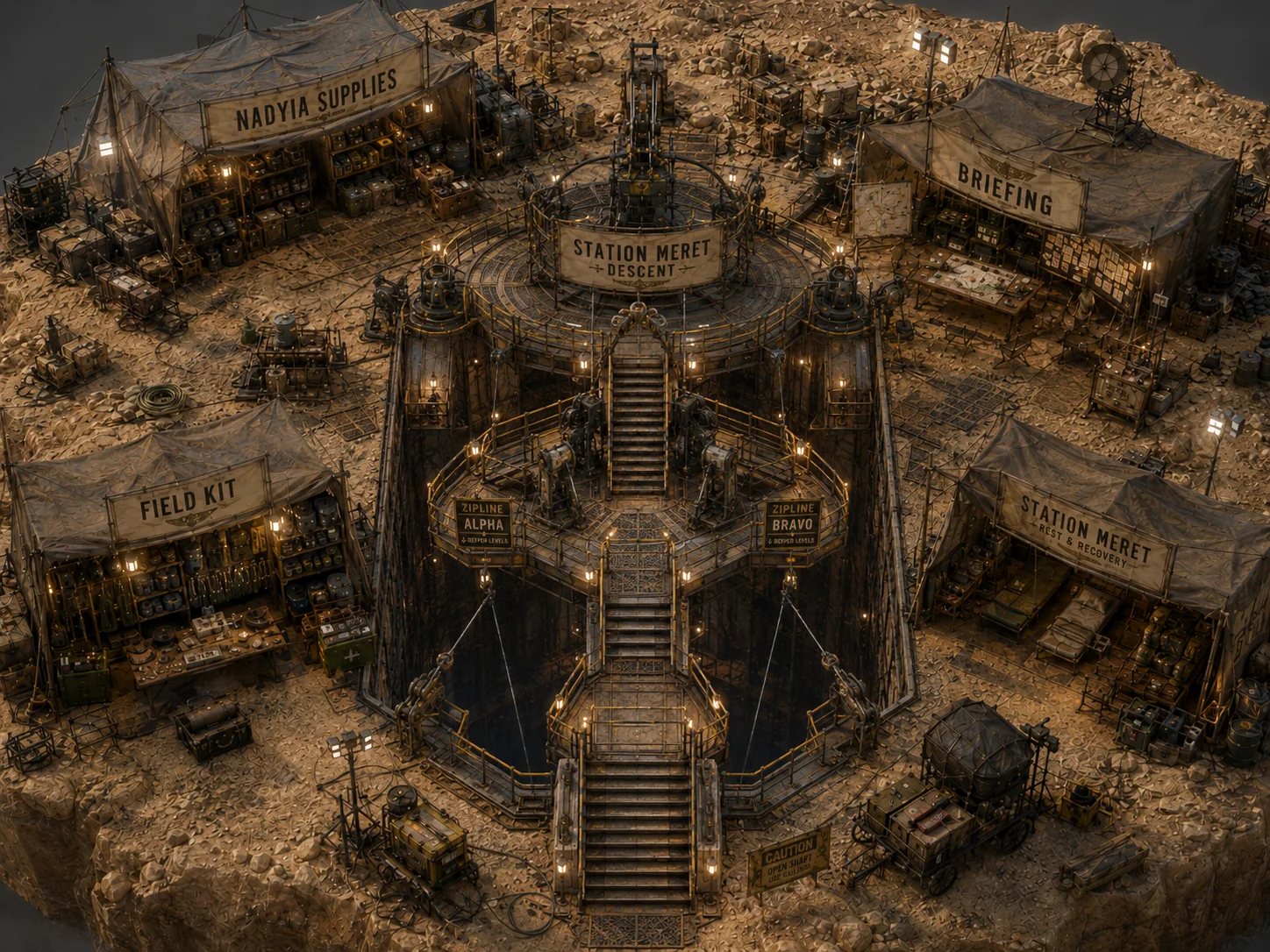
Camp Ibis: canvas supply tents, briefing table and a lit descent shaft cut into the desert floor
Camp IbisNadyia Supplies, the field kit tent, the briefing board and the descent collar. The only place above ground where the archive cannot hear you clearly.
Station Meret descent: a lit circular gantry with two ziplines over an unlit shaft
Station Meret · DescentThe descent stack over the open shaft. Zipline Alpha and Zipline Bravo both go to deeper levels. Neither of them comes back up.

Plate 04

You are a Rook, and there have been others

Respawn is not a convenience in this game, it is the horror. You come back as VERSION 7. Then VERSION 12. Eventually the crew has to decide whether the person who came back from the last expedition is the same person who went down.

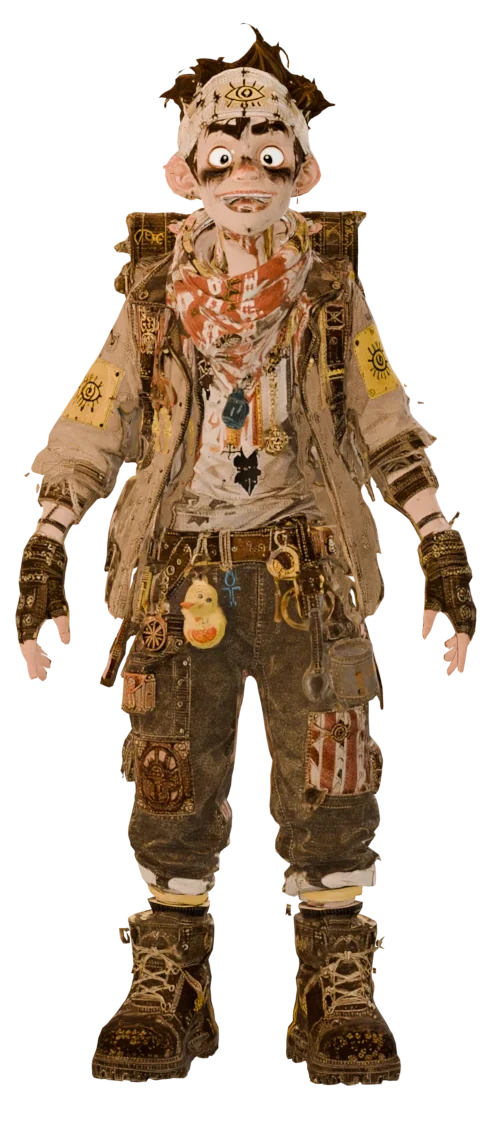
Rook OperatorIdle · production model
Loop · muted
Built · 1.80 m · in the runtime

Resonance Recovery Operator

Rooks are 1987 desert recovery workers on a memory-extraction contract they have not read carefully. Layered expedition clothing, wrapped scarves, climbing harness, charm cords, analog instruments and a resin hand torch, because digital equipment fails near the site and only flame stays reliable.

Customisation is deliberately broad: four body frames, five outfits, ten cloth colours, eight skin tones, six headgear sets, five masks, eight face tattoos, six charms and four wear states. That breadth is not vanity. Your friends have to recognise you in near-total darkness at a glance.

What a Rook publishes about themselves is one number. Exposure folds crouching, darkness, movement and carried flame together, and that number is the only thing the tomb gets to read. Crouch in the dark with the torch out and you are close to unreadable.
The full roster

360° turnaround

Rook Operator000°
Loading 0%

Plate 05

Where the build is

Reconciled against the project's own state documents on 22 August 2026. Host and Join are visible in the menu and deliberately disabled, because lobbies do not work yet and we would rather say that than ship a button that lies.

  • Single-player prototype

    Built

    Menu, settings, wardrobe, pause and respawn, salvage and quota loop, working flashlight.

  • Sound model

    Built

    NoiseField and the sensory foundation the whole design rests on.

  • Monster roster

    Built

    Four creatures modelled, rigged, animated and hunting. Correctly scaled.

  • Steam integration

    Built

    Steamworks initialises successfully.

  • Standard Recovery Rook

    In build

    Clay rebuild in progress and not yet approved. It gates the art pipeline.

  • Lobbies and networked play

    In build

    FishNet and Steam relay work is open. Host and Join stay disabled in the build until they actually work.

  • Proximity voice

    Specified

    Phase 2. Depends on networking landing first.

  • Voice mimicry

    Specified

    Phase 3. The signature mechanic, and the first thing after voice.

All art and audio in the project is CC0 or procedurally generated, so there is no licence cost and nothing blocking commercial release. Networking is FishNet on the free tier; Steam integration is Steamworks.NET under MIT.